
Forget Silicon Valley:
Is Europe Building Something Better?
 By Mohamed El Kharrati
 Founder of FactCheckTool • February 27, 2026 • 15 min read
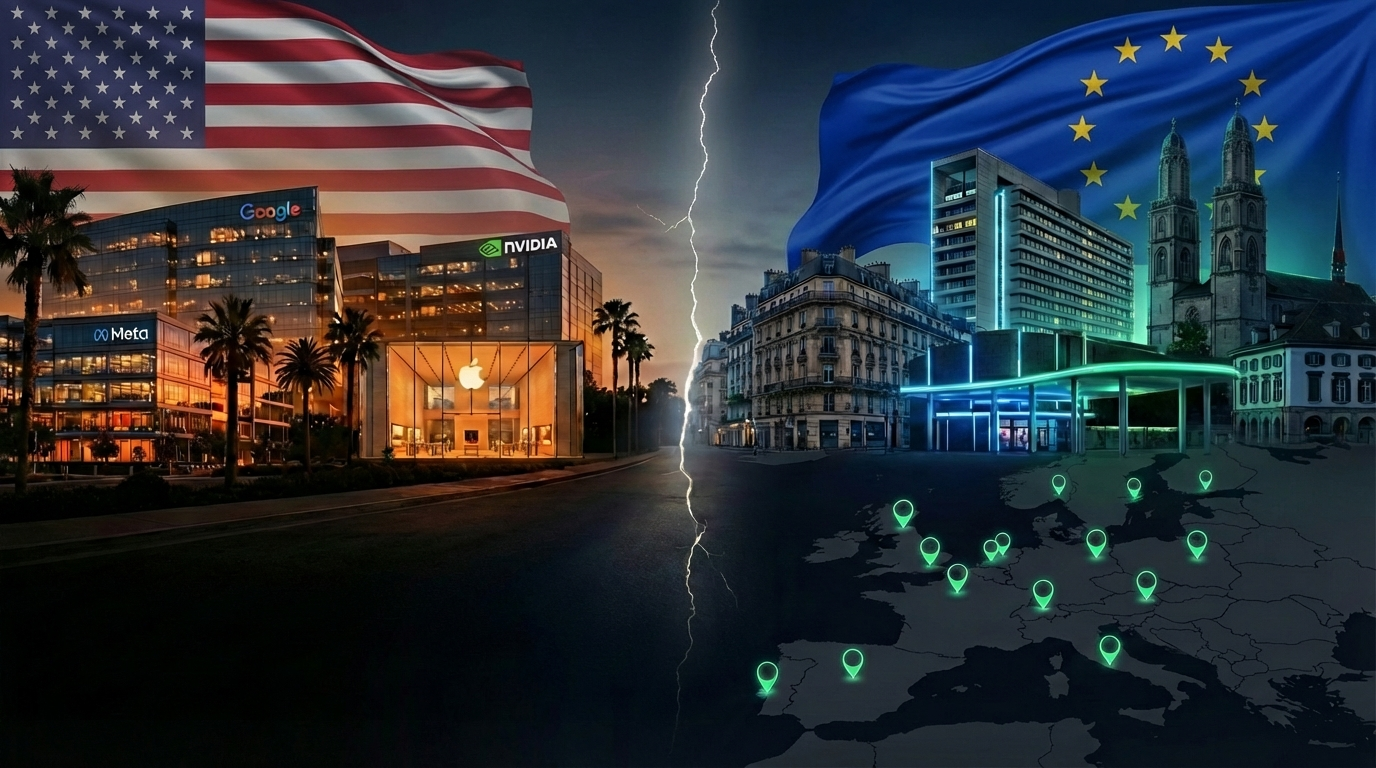
From the Rif Mountains to the European Dream
I grew up in the Rif Mountains of Morocco - a place with no startup culture, no venture capital, no pitch decks. Just the belief that if you crossed into Europe and worked hard enough, things would be different. I still believe that. But the data tells a more complicated story.
I came to Europe looking for a level playing field. I found one - eventually. From Switzerland, I built CoHive.ch, a holding company for a small ecosystem of European digital tools, all bootstrapped, zero VC:
None of these are unicorns. All of them solve real problems for real people - built in Europe, by someone who came from nothing, and found the European dream harder than advertised. And yet, almost every week, I ask myself: why is it so much harder here than it should be?
Silicon Valley: From Government Labs to $14 Trillion
Nobody built Silicon Valley by accident. The story people tell - garage startups, lone geniuses, pure free-market magic - is a myth, or at least a very incomplete truth. The real story starts with the US government.
The 1950s–1980s: DARPA built the foundation
After Sputnik launched in 1957, the US government created DARPA - the Defense Advanced Research Projects Agency - with one explicit mission: never be caught off guard technologically again. DARPA funded the internet (ARPANET), GPS, voice recognition, early AI, and touchscreen interfaces. It was not a venture fund. It was a national bet, paid for by taxpayers, with no expectation of quarterly returns.
Stanford and Berkeley sat right in the middle of all this. They trained the engineers. They spun out the companies. The government provided the rocket fuel. The universities lit the fuse.
The 1990s: The internet changes everything
By 1990, the commercial internet was just beginning. By 2000, it had produced the largest asset bubble in history. Venture capital flooded in - peaking at $105.5 billion in the year 2000 alone. The dot-com crash came hard. Funding collapsed to $20.9 billion by 2004. But crucially, the infrastructure survived. The engineers stayed. The culture of risk-taking survived the wreckage.
That is the part Europe tends to miss: in Silicon Valley, failure is not the end of a story. It is chapter one.
US Venture Capital Funding - Dot-com to AI era ($B)
Sources: NVCA, Crunchbase, Silicon Valley Indicators
2000s–2010s: The social media wave
From the ashes of the dot-com crash came a new generation. Facebook was founded in 2004. Twitter in 2006. Airbnb in 2008. Even during the 2008 financial crisis, Valley companies kept raising. LinkedIn and Facebook were already redefining what "scale" meant. Europe watched. Some European founders joined. Many never came back.
Why Apple and Nvidia actually won
People love to attribute Apple's success to Steve Jobs's genius. And yes, Jobs was extraordinary. But Apple was also a beneficiary of government-funded research: the touchscreen, GPS, SIRI's voice recognition, and cellular networks were all built on publicly funded science. The iPhone was not invented in a garage. It was assembled from decades of taxpayer-funded R&D.
Nvidia is even more instructive. Nvidia was not originally an AI company. It made graphics cards for video games. But in 2012, DARPA awarded Nvidia a contract worth up to $20 million for embedded processor research. The company went all-in on GPU computing. When the AI boom arrived, Nvidia had the only chips capable of training large language models at scale. Today, Nvidia's market cap exceeds $3 trillion. It is not a coincidence. It is the result of a long-term, government-backed bet on computing infrastructure.
Source: UPPCS Magazine
2024: The AI mega-boom
The AI era has supercharged every existing advantage. In 2024, Bay Area startups alone raised $90 billion in venture capital, 57% of all US venture funding and roughly half of all global VC. Single companies raised what entire European ecosystems see in a year: xAI raised $12 billion. Anthropic raised $8+ billion. Databricks raised $10 billion.
Why There Is No European ChatGPT - And What That Actually Means
Let us be blunt. In 2024, US institutions produced 40 notable AI models. China produced 15. Europe produced 3. The US controls roughly 75% of global AI compute capacity - Europe holds around 5%. That is approximately 15 times the infrastructure. OpenAI has raised $11.3 billion. Anthropic: $8.7 billion. Mistral AI - Europe's closest answer - is still fighting for relevance on a fraction of that funding.
Why? It is not because European researchers are less intelligent. European universities produce world-class AI talent. The problem is what happens after graduation. European AI researchers leave - mostly to the US - at an accelerating rate. Net tech talent inflows to Europe fell from 52,000 in 2022 to just 26,000 in 2024. Germany and France both lose more AI professionals than they gain every year.
The compute problem is structural. European AI companies that need to train large models - like Mistral - have to outsource their compute to US-based hyperscalers: Amazon, Microsoft, Google. They literally cannot train at scale on European soil because the GPU infrastructure does not exist at the required scale. Nvidia's CEO Jensen Huang said it plainly in 2024: "European nations need to invest more in AI if they want to close the gap."
Notable AI Models Produced in 2024 - By Region
Source: Index.dev, CNBC, McKinsey
But here is the contradiction worth sitting with: Is a foundational AI model even the right goal for Europe? McKinsey argues that Europe's real opportunity is not in building the next GPT-4 - it is in building the application layer. The tools, the compliance, the trust infrastructure. Things that require European values, European context, European users. Things like, arguably, FactCheckTool.
What Europe Has Built - And What the Numbers Say
Europe is not failing. Let us be clear about that. It is growing - just unevenly, and at a pace that does not match its own potential.
The funding gap is real and widening
In 2024, European startups raised $51 billion in venture capital. That sounds large until you compare it to the US: $178 billion. That is a 3.5x gap - and it is not closing. Every year, US startups attract 6–8 times more VC than EU startups. Even combining the entire EU and UK, US funding runs 3–4x higher, for economies of roughly equal size.
Startup VC Funding in 2024 - EU vs USA ($B)
Sources: Crunchbase, State of European Tech 2024
Valuations are discounted by default
It is not just about the volume of funding. European startups are systematically undervalued. Average valuations in Europe are 38% to 52% lower than comparable US companies across funding stages. At Seed stage, European valuations are more than 50% below US equivalents. At Series A the discount is around 38%. That means European founders raise less money, give up more equity, and start the race already behind.
Source: Atomico - State of European Tech, Equidam Valuation Delta Q3 2024
3 out of 4 successful European startups end up American
Here is the number that should keep every European policymaker up at night: 44% of European startup acquisitions are performed by US companies. North American companies acquire European startups at four times the rate of European acquirers.
Think about what that means. Europe builds the talent. Europe funds the early stages. And then, when a startup reaches the inflection point - the moment it could become a European champion - it gets bought by Google, Microsoft, or Meta. Skype: sold to Microsoft. DeepMind: sold to Google. Waze: sold to Google. ARM: sold to SoftBank (and very nearly to Nvidia). The list is long.
Source: Euronews, Jan 2026
Institutional capital is absent
In the US, institutional investors - pension funds, insurance companies, endowments - provide 72% of venture capital. In Europe, that number is 30%. US pension funds allocate about 11% of their portfolios to private equity and VC. European pension funds: 4.3%. The result is that European VC funds are structurally undercapitalized before they even write a single check.
When the US Sends Diplomats to Kill Your Privacy Laws
On February 18, 2026, a State Department cable signed by Secretary Marco Rubio instructed American diplomats worldwide to actively oppose data sovereignty laws. The cable explicitly named the GDPR as an example of "unnecessarily burdensome" regulation. Diplomats were told to "counter unnecessarily burdensome regulations, such as data localization mandates" and to stress that they "will disrupt global data flows."
"This is not a trade dispute. This is a diplomatic offensive against the right of countries to control their own data."
Dante Emilio Grassi, Founder of EU Tech MapThe timing is not random. US AI companies - OpenAI, Google, Anthropic, Meta - are training the next generation of models on data collected at planetary scale. European data protection laws threaten that pipeline. So instead of operating within the rules, the US government is now lobbying to kill the rules before they take root.
This is worth sitting with: the most powerful government in the world is spending diplomatic capital to prevent your government from protecting your data. Not because the laws are bad. Because they are inconvenient for Silicon Valley.
Source: PPC Land, Reuters / Yahoo Finance
What Is Europe Actually Missing?
Let us stop pretending the answers are simple. Here are the real questions:
Why does Europe produce world-class AI researchers who then move to San Francisco?
Because San Francisco pays 3–5× more, offers equity that could make them millionaires, and surrounds them with peers building at the frontier. Salaries and equity structures in European startups simply cannot compete - yet.Why do European pension funds park money in US Treasury bonds instead of European startups?
Because regulation, risk aversion, and fiduciary duty frameworks have not evolved to treat VC as a credible asset class. Until European pension funds move from 4.3% to closer to 11% allocation, the capital gap will persist structurally.Why is it easier to build a startup in one US state than in 27 EU member states?
Fragmentation is Europe's original sin. A startup operating across France, Germany, and Spain faces three different regulatory regimes, three different tax systems, and three different hiring laws. The US has one market of 330 million. Europe has 27 markets adding up to 450 million - but they do not behave like one.Is GDPR a competitive handicap or a strategic asset?
Both. In the short term, it creates compliance overhead that US competitors do not face. In the long term, it is a moat. The companies that figure out how to build privacy-first AI tools have an addressable market of 450 million high-trust users - and the rest of the world is moving toward GDPR-style regulation anyway.Why do Europe's best startups keep getting acquired instead of going public?
European public markets are thin, illiquid, and skeptical of high-growth tech valuations. Without a viable IPO path, the exit for most European founders is either selling to a US company or raising from US funds that will eventually push them toward a US listing anyway. The exit infrastructure is broken.Forget Silicon Valley - Maybe That Is Exactly the Point
Here is the thing about the question in our title: it contains a hidden assumption. It assumes Europe should want to be Silicon Valley. But what if the better question is: what could Europe build that Silicon Valley cannot?
Silicon Valley optimizes for scale, growth, and shareholder returns at any cost. It has given us the smartphone, the cloud, social media, and large language models. It has also given us surveillance capitalism, algorithmic addiction, the erosion of privacy, and a handful of companies that know more about you than your own government does.
Europe could build something different. Not slower. Not weaker. Different. Technology built on a foundation of trust. Tools that work with democratic values, not against them. AI that is explainable, auditable, and accountable - because the people using it demanded it.
That is not a consolation prize. That is a genuine competitive advantage - if Europe has the courage to claim it.
The Builders Who Are Not Waiting for Permission
While policymakers debate and pension funds deliberate, some people are simply building. They are not waiting for a European DARPA or a Brussels mandate. They are taking the initiative themselves. Here are two examples - both started by people who believe Europe is worth betting on.
EU Tech Map — Built by Dante Emilio Grassi
EU Tech Map is one of the most quietly important projects in the European tech ecosystem right now. Built by Dante Emilio Grassi, it maps 1,600+ European tech tools - products built with data sovereignty and GDPR in mind. Its premise is simple but powerful: if you do not know European alternatives exist, you will default to American ones. Visibility is the first step toward choice.
When Dante posted about the Rubio cable on LinkedIn, he did not frame it as a threat. He framed it as confirmation. "This is exactly why EU Tech Map exists," he wrote. "Not as an anti-American project. But as a reminder that European alternatives are real, functional, and increasingly necessary."
That framing matters. This is not about hating America. It is about being serious about Europe.
FactCheckTool.com — Built in Switzerland
We built FactCheckTool.com in Bulle, Switzerland. No Silicon Valley funding. No US investor demanding growth-at-all-costs. A tool that uses AI to fight misinformation - built with European data standards, hosted on European infrastructure, and designed for users who care about where their data goes.
Is it the next $10 billion company? Maybe not. But it is real, it is growing, and it is ours. Every European founder who builds something like this - no matter how small - is a vote for a different kind of tech future. The answer to Silicon Valley's dominance is not a single European champion. It is a thousand builders, across twenty-seven countries, building one product at a time.
What Needs to Change - And What You Can Do
For policymakers
- Reform pension fund allocation rules to allow and incentivize VC investment. Move from 4.3% toward 8–10%.
- Create a true single digital market - one set of startup regulations, one set of employment laws for scaling tech companies, one tax framework for equity compensation.
- Build European GPU infrastructure so AI companies can train models at scale without depending on US hyperscalers.
- Reform public market listings to make European IPOs viable for high-growth tech companies.
For founders and builders
- Stay. The best thing a European founder can do for the ecosystem is build here, list here, and hire here.
- List on EU Tech Map. Visibility is not vanity - it is infrastructure.
- Build on your values, not in spite of them. Privacy-first, GDPR-compliant, accountable AI is not a constraint. It is your moat.
For users and citizens
- Choose European tools when they exist. Every subscription to a US platform instead of a European equivalent is a small vote against European tech.
- Understand what your data funds. The free tools are not free. They are paid for with data that trains the next generation of AI models.
So - Is Europe Building Something Better?
Not yet. Not at scale. Not fast enough. But the ingredients are there. The talent is there. The values are there. What is missing is urgency, capital, and belief.
I came from the Rif Mountains believing that Europe was a place where things could be built. I still believe that. But belief is not enough. Action is.
The answer to Silicon Valley is not to copy it. It is to build something Europe can actually be proud of. Something that works because of European values, not in spite of them.
We are trying to do that with FactCheckTool. Dante is doing that with EU Tech Map. And there are thousands of builders across this continent doing the same, quietly, every day.
The question is not whether Europe can. The question is whether Europe will.
Sources & Further Reading
- TechCrunch - Silicon Valley devoured 57% of US VC in 2024
- Crunchbase - Europe startup funding stabilized at $51B in 2024
- Index.dev - Global AI Model Race: Who Leads?
- Euronews - The AI brain drain: Why Europe can't keep the talent it trains
- Reuters - US orders diplomats to fight data sovereignty initiatives
- Nvidia Newsroom - Nvidia DARPA contract $20M, 2012
- Sifted - 13 European unicorns in 2024
- Mind the Bridge - 3 out of 4 European startups acquired by US companies
- CEPR - The venture capital challenge for Europe
- McKinsey - Europe's AI opportunity
- Epoch AI - AI Supercomputer Performance Share by Country
- OECD - AI firms capture 61% of global venture capital in 2025 (Feb 2026)
- Atomico - State of European Tech 2025
- Sifted - Europe's tech talent inflow collapses (Atomico data)